
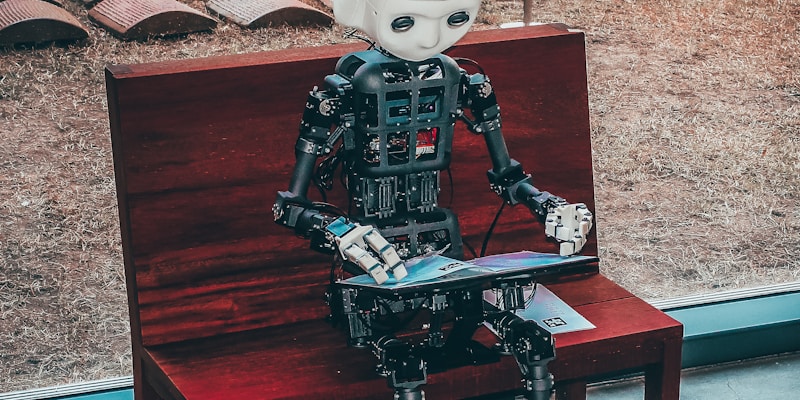
Introduction to Reinforcement Learning
Reinforcement Learning (RL) is a powerful paradigm in machine learning where agents learn to make decisions through interaction with an environment. Unlike supervised learning, RL doesn't rely on labeled datasets but instead learns from trial and error, receiving rewards or penalties for actions taken.
The Core Components
At its heart, reinforcement learning consists of several key components that work together:
- Agent: The learner or decision-maker that takes actions
- Environment: The world with which the agent interacts
- State: The current situation or configuration of the environment
- Action: The choices available to the agent at each state
- Reward: The feedback signal indicating how good the action was
- Policy: The strategy the agent uses to decide which action to take
How Reinforcement Learning Works
The learning process follows a simple but powerful loop:
The RL Learning Loop
- The agent observes the current state of the environment
- Based on its policy, the agent selects an action
- The environment transitions to a new state
- The agent receives a reward or penalty
- The agent updates its policy based on this feedback
- The process repeats, with the agent improving over time
Real-World Applications
Game Playing
RL has achieved remarkable success in game playing, from classic board games to complex video games. AlphaGo's victory over world champion Go players demonstrated RL's ability to master strategies that humans developed over thousands of years.
Robotics
In robotics, RL enables machines to learn complex motor skills through practice. Robots can learn to walk, grasp objects, and perform delicate tasks by receiving feedback on their movements and adjusting accordingly.
Autonomous Vehicles
Self-driving cars use reinforcement learning to make split-second decisions in complex traffic scenarios. They learn to balance safety, efficiency, and passenger comfort through millions of simulated driving experiences.
Key Algorithms in Reinforcement Learning
Q-Learning
A model-free algorithm that learns the value of actions in states without requiring a model of the environment. It's particularly effective for problems with discrete state and action spaces.
Deep Q-Networks (DQN)
Combines Q-learning with deep neural networks to handle high-dimensional state spaces, enabling RL to work directly with raw sensory inputs like images.
Policy Gradient Methods
Directly optimize the policy function rather than learning value functions, making them suitable for continuous action spaces and stochastic policies.
Challenges and Limitations
While powerful, reinforcement learning faces several challenges:
- Sample Efficiency: RL often requires millions of interactions to learn effectively
- Exploration vs. Exploitation: Balancing trying new actions with using known good strategies
- Reward Design: Crafting appropriate reward functions is crucial and challenging
- Safety: Ensuring safe exploration in real-world environments
- Generalization: Transferring learned skills to new situations
The Future of Reinforcement Learning
The field continues to evolve rapidly with exciting developments:
- Meta-Learning: Agents that learn how to learn more efficiently
- Multi-Agent RL: Systems where multiple agents learn to cooperate or compete
- Hierarchical RL: Breaking down complex tasks into simpler subtasks
- Offline RL: Learning from fixed datasets without environment interaction
- Human-in-the-Loop RL: Incorporating human guidance and preferences
Getting Started with RL
For those interested in exploring reinforcement learning, here are some recommended starting points:
- Study the classic book "Reinforcement Learning: An Introduction" by Sutton and Barto
- Experiment with OpenAI Gym for standardized environments
- Try implementing simple algorithms like Q-learning from scratch
- Explore RL frameworks like Stable Baselines3 or Ray RLlib
- Join online communities and follow recent research papers
Conclusion
Reinforcement learning represents a fundamental shift in how we approach machine learning, moving from pattern recognition to goal-directed learning. As algorithms become more sophisticated and computational resources increase, RL will continue to unlock new possibilities in artificial intelligence, from autonomous agents to creative problem-solving systems.
"Reinforcement learning is not just about teaching machines to play games; it's about teaching them to learn from experience and make intelligent decisions in complex, uncertain environments."
- Sarah Johnson


